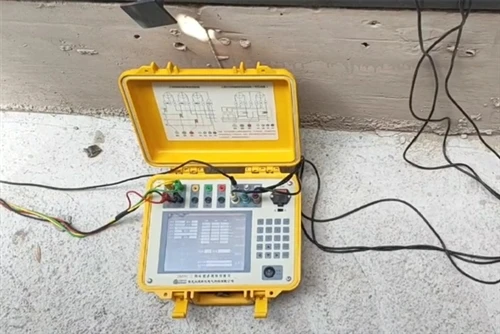
The Earth Resistance Tester Clamp Meter has become widely adopted in power operation and lightning protection testing, yet field misuse remains common. Many operators treat it as a universal meter, taking readings directly on isolated grounding electrodes and obtaining meaningless values. Understanding the physical prerequisites of this instrument matters more than memorizing operating steps.
Core Prerequisite: A Closed Loop Is Essential
The working principle of a clamp meter determines that it measures not the resistance of a single grounding electrode to earth, but the impedance of the entire loop. The high-frequency signal injected by the jaw must travel through the tested electrode, the earth, other parallel grounding electrodes, and back to the jaw to form a closed path. Therefore, only in multiple-grounding systems do the readings carry reference value. If the tested electrode has no electrical connection to other grounding bodies, the loop does not exist and the reading is invalid.
Common Misuse Scenarios
First, using the Earth Resistance Tester Clamp Meter directly during new station commissioning, when the grounding grid is not yet connected to other systems and measurement conditions are not met. Second, measuring on an independent grounding installation with a single down-conductor, where a loop cannot be formed. Third, ignoring interference currents and taking readings directly on grounding conductors near high-voltage lines or traction power systems, resulting in significant deviations. Some models provide warnings when strong interference is detected, but operators who overlook these warnings may still record erroneous data.
Practical Recommendations
Before field work, confirm the topology of the grounding system and determine whether an effective parallel loop exists. Where this cannot be confirmed, it is advisable to first obtain a baseline value using the traditional three-pole method, then cross-check with the Earth Resistance Tester Clamp Meter. For measurement points requiring long-term tracking, fix the measurement position and clamp orientation to reduce data fluctuations caused by human factors.