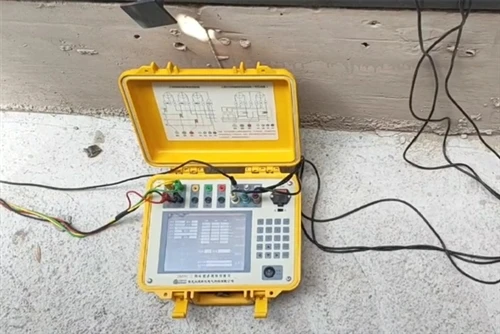
The Earth Resistance Tester Clamp Type is a portable grounding resistance measuring instrument designed based on electromagnetic induction principles. Its most distinctive feature is that measurement requires neither disconnecting the grounding down-conductor nor driving auxiliary stakes. Compared with traditional three-pole or four-pole methods, this instrument simplifies the measurement process to "clamp and read," offering clear field efficiency advantages in locations with dense grounding networks such as urban substations, communication base stations, and gas stations.
In terms of working principle, the clamp jaw integrates a voltage injection coil and a current detection coil. The instrument injects a fixed-frequency AC signal (typically 1.6 kHz to 2.2 kHz) into the grounding loop under test, deliberately avoiding power-line frequencies and their low-order harmonics to reduce interference. The induced current is captured by the detection coil, and the instrument converts it into a loop resistance value according to Ohm's law. Since the entire measurement process does not require disconnecting the grounding conductor, the Earth Resistance Tester Clamp Type is particularly suitable for routine inspection of equipment in operation.
However, this principle also determines its application boundaries. The instrument requires that the tested grounding electrode forms a complete current path through other parallel grounding electrodes or a low-resistance loop. For isolated grounding electrodes, newly installed grounding systems not yet in service, or situations with only one grounding down-conductor, the clamp method cannot form an effective loop, and measurement results will lose reference value. In addition, when strong interference currents exist in the grounding conductor, some Earth Resistance Tester Clamp Type models display a noise warning, prompting operators to change test points or switch to traditional methods for verification.
When selecting a model, it is advisable to focus on measurement range, clamp jaw size, noise immunity, and whether data storage and export functions are supported. For power operation and maintenance units requiring batch inspection, models with alarm threshold settings and USB data transmission can significantly improve work efficiency.