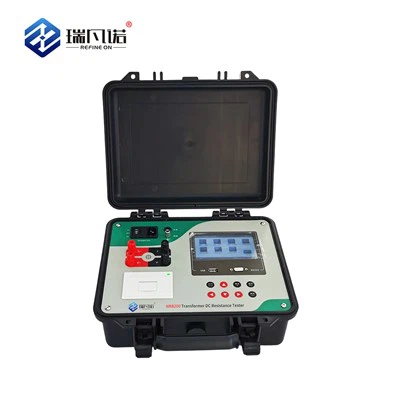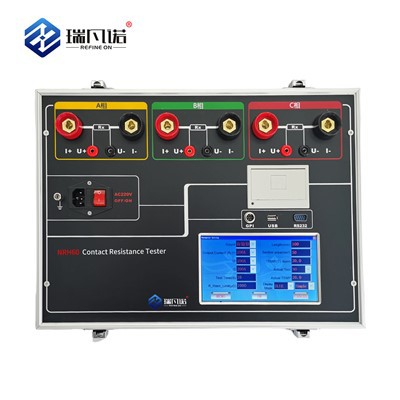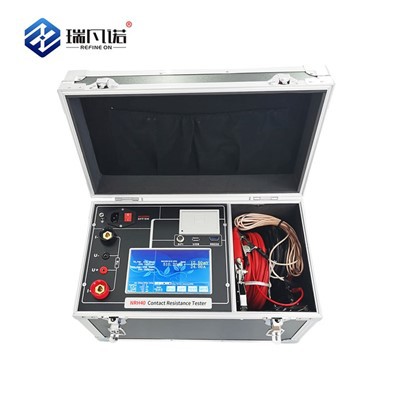

Interpreting the measurement results of a Transformer Dc Resistance Tester can be a bit of a head - scratcher, especially if you're new to the game. But don't worry! As a supplier of Transformer Dc Resistance Tester, I'm here to break it down for you in a way that's easy to understand.
Why Measure DC Resistance in Transformers?
Before we dive into result interpretation, let's quickly talk about why we measure DC resistance in transformers in the first place. Measuring the DC resistance helps us detect issues like short - circuited turns in the windings, open circuits, and problems with the connections. It's like a health check for your transformer, and the DC resistance values can give you a clear picture of the transformer's condition.
Understanding the Measurement Basics
When you're using a Transformer Dc Resistance Tester, it sends a direct current through the transformer winding and measures the voltage drop across it. Then, using Ohm's Law (V = IR, where V is voltage, I is current, and R is resistance), it calculates the resistance of the winding. Simple enough, right?
Interpreting the Results
1. Comparing Phase - to - Phase Resistance
One of the first things you'll want to do is compare the DC resistance values of different phases. In a healthy three - phase transformer, the resistance values of all three phases should be relatively equal. A significant difference between phases can indicate a problem. For example, if one phase has a much lower resistance than the others, it could mean there's a short - circuit in that phase.
Let's say you measure the DC resistance of Phase A as 0.5 ohms, Phase B as 0.52 ohms, and Phase C as 0.51 ohms. These values are pretty close, which is a good sign. But if Phase A was 0.1 ohms while the others were around 0.5 ohms, you'd definitely want to investigate further.


2. Comparing with Nameplate Values
Most transformers come with nameplate data that includes the expected DC resistance values. You should always compare your measured values with these nameplate values. If the measured resistance is significantly higher or lower than the nameplate value, it could indicate a problem.
A higher than expected resistance might be due to a loose connection, corroded terminals, or an open - circuit in the winding. On the other hand, a lower than expected resistance could be a sign of short - circuited turns.
3. Temperature Considerations
Resistance is temperature - dependent. As the temperature of the winding increases, so does its resistance. That's why it's crucial to record the temperature at the time of measurement. You can then use a temperature correction formula to adjust the measured resistance to a standard temperature (usually 20°C or 25°C).
The formula for temperature correction is (R_2=R_1\frac{T_2 + k}{T_1 + k}), where (R_1) is the measured resistance, (T_1) is the measured temperature, (T_2) is the standard temperature, and (k) is a constant (234.5 for copper and 225 for aluminum).
Other Related Tests and Their Significance
While the Transformer Dc Resistance Tester is a powerful tool, it's often used in conjunction with other tests to get a more comprehensive view of the transformer's condition.
Winding Resistance Test Set
A Winding Resistance Test Set is similar to a DC resistance tester but may offer more advanced features and higher accuracy. It can be used to perform more detailed resistance measurements, especially in high - voltage transformers. The results from a winding resistance test set can be interpreted in a similar way to those of a DC resistance tester, but the higher precision can help detect even smaller discrepancies.
Dissipation Factor Tester
The Dissipation Factor Tester measures the dielectric loss in the transformer insulation. A high dissipation factor can indicate moisture, contamination, or aging of the insulation. By combining the results of a DC resistance test with a dissipation factor test, you can get a better understanding of both the electrical and insulation conditions of the transformer.
VLF Hipot Tester
A VLF Hipot Tester is used to perform a voltage withstand test on the transformer insulation. It applies a high - voltage, low - frequency signal to the insulation to check for any weaknesses or breakdowns. If the DC resistance test shows no obvious problems but the hipot test fails, it could mean there are hidden insulation issues that need to be addressed.
Transformer On - load Tap - changer Tester
The Transformer On - load Tap - changer Tester is used to test the performance of the on - load tap - changer in a transformer. The on - load tap - changer allows the transformer to adjust its voltage ratio while it's still energized. A DC resistance test can be used to check the continuity of the tap - changer contacts, and the results can help determine if any maintenance or replacement is needed.
Troubleshooting Based on Results
If your DC resistance test results show a problem, here are some steps you can take to troubleshoot:
- Check the connections: Make sure all the connections between the tester and the transformer are tight and clean. Loose or corroded connections can cause inaccurate readings.
- Inspect the windings visually: Look for any signs of physical damage to the windings, such as burnt insulation or broken wires.
- Perform additional tests: As mentioned earlier, use other testing equipment like a dissipation factor tester or a VLF hipot tester to get more information about the transformer's condition.
Final Thoughts and Call to Action
Interpreting the measurement results of a Transformer Dc Resistance Tester is an important skill for anyone involved in transformer maintenance and testing. By understanding how to read and analyze these results, you can identify potential problems early and take the necessary steps to prevent costly breakdowns.
If you're in the market for a high - quality Transformer Dc Resistance Tester or any of the related testing equipment we mentioned, don't hesitate to reach out. We're here to help you make the right choice for your specific needs and ensure you get accurate and reliable test results.
References
- "Transformer Testing Guide", Electrical Apparatus Service Association (EASA)
- "Power Transformer Testing and Diagnosis", IEEE Press