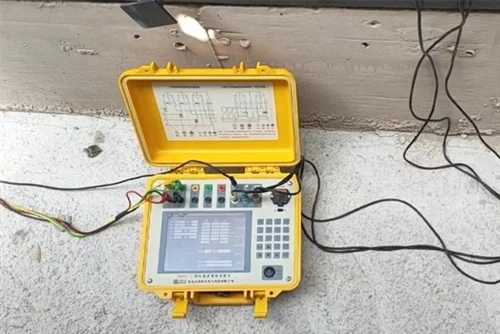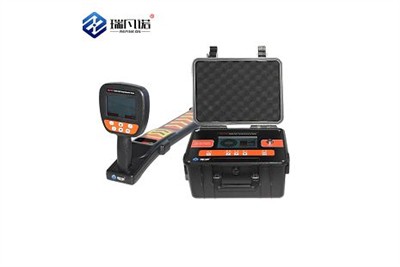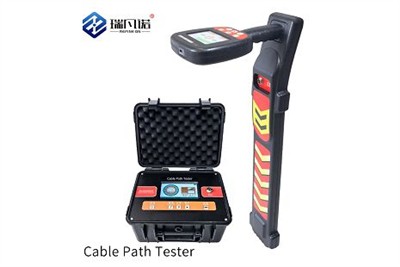
Partial discharge testers can be categorized by their detection principle into high-frequency partial discharge detectors (using high-frequency current sensors (HFCT), detection band 3-30MHz), ultra-high frequency partial discharge detectors (detection band 300-3000MHz), ultrasonic partial discharge detectors (including contact and non-contact types, frequency range 20-200kHz), and transient ground voltage partial discharge detectors (measurement band 3-100MHz). Based on usage, they can be classified as handheld portable systems, benchtop testing systems, and online monitoring systems.
Common technical parameters of partial discharge testers include detection sensitivity, measurement band, sampling rate, and accuracy. Detection sensitivity is a key indicator of an instrument's ability to detect weak discharge signals, typically reaching the pC (picocoulomb) level, such as as low as 0.1pC or 10pC. The measurement band refers to the effective signal frequency range that the instrument can detect; different instruments based on different principles have significantly different bands, such as 10kHz-300kHz, 3-30MHz, 300-3000MHz, etc. Sampling rate and accuracy affect the capture and reconstruction of signal details. Sampling rates can reach 0.1μs/point per channel or higher (e.g., 250M/s), and common sampling accuracies include 8-bit, 12-bit, and 16-bit. Dynamic range and linearity error are also important parameters. Dynamic range can reach 120dB, and linearity error is typically required to be ≤±10%. Synchronization methods include internal synchronization and external synchronization, used to correlate the discharge signal with the power frequency voltage phase. Other parameters, such as operating power supply (e.g., AC 220V), size and weight, and number of detection channels, directly affect the instrument's portability and applicable scenarios. Different models (e.g., XD56 series, (dual-channel) partial discharge tester, handheld partial discharge detector, PD-SGS, etc.) have different focuses in specific parameters and functional configurations.