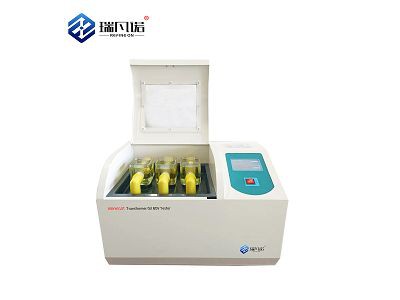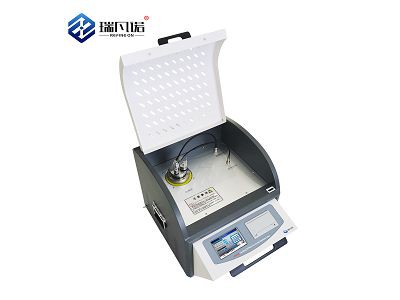
Under AC voltage, dielectrics consume some electrical energy, which is converted into heat energy and lost. This energy loss is called dielectric loss. When an AC voltage is applied to the dielectric, there is a phase angle difference ψ between the voltage and current in the dielectric. The complementary angle δ of ψ is called the dielectric loss angle, and the tangent tanδ of δ is called the dielectric loss tangent. The tanδ value is a parameter used to measure dielectric loss. The instrument's measurement circuit includes a standard circuit (Cn) and a test circuit (Cx). The standard circuit consists of a built-in high-stability standard capacitor and the measurement circuit, while the test circuit consists of the test sample and the measurement circuit. The measurement circuit consists of a sampling resistor, a preamplifier, and an A/D converter. The measurement circuit measures the amplitude and phase difference of the current in the standard circuit and the test circuit, respectively. Then, a digital signal processor (or microcontroller) uses a digital real-time acquisition method to calculate the capacitance value and dielectric loss tangent of the test sample through vector calculation.
The main methods for measuring dielectric loss factor (tgδ) include the direct connection method (test sample ungrounded), the reverse connection method (test sample grounded), and the self-excited method for measuring capacitive voltage transformers (CVTs). In the self-excited method for CVT measurement, C1 is used as the standard capacitor in the bridge circuit. The capacitance ratio of C2 to C1 and the relative dielectric loss value can be measured, thus calculating the actual value of C2.
To suppress power frequency interference in the field, modern instruments widely employ frequency conversion methods (different frequency measurements). By changing the test frequency (e.g., using combinations of 45Hz/55Hz, 55/65Hz, etc.) and using digital filtering techniques (e.g., Fourier transform), the fundamental frequency of the signal is separated, effectively filtering out power frequency interference signals. In addition, early anti-interference methods included phase inversion and phase shifting.
The instrument has multiple safety protection measures, including high-voltage short-circuit protection, overcurrent protection, grounding failure protection, anti-misoperation (e.g., two-stage power switch, multiple button confirmation), anti-"capacitive rise" effect (automatic tracking of output voltage to maintain constancy), and vibration-resistant design.
Some high-end models support a variety of extended functions, including CVT (capacitive voltage transformer) ratio and phase measurement, insulation resistance measurement (including absorption ratio and polarization index), LCR measurement (inductance, capacitance, and resistance), and large-capacity testing with external standard capacitors or external high-voltage sources (such as series resonant power supplies).